
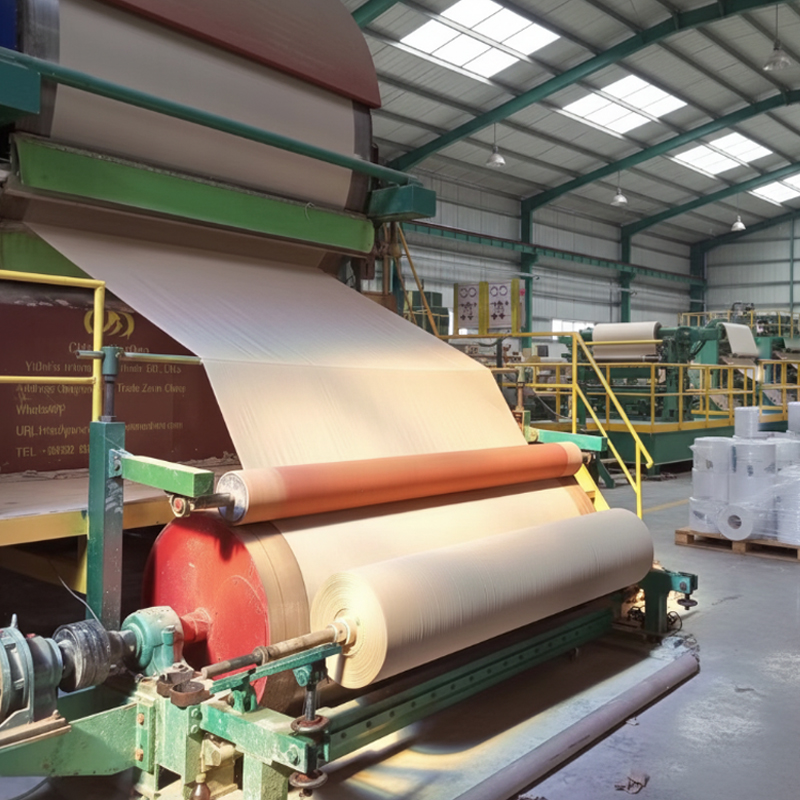
Shandong, China – March 27, 2026 – As the global push for sustainability intensifies, the industrial sector is witnessing a significant shift away from traditional wood-based paper production. In response to the rising demand for alternative fibers, a new generation of integrated manufacturing technology—the Bamboo Pulp System Toilet Paper Making Machine—is emerging as a game-changer, offering a closed-loop solution that combines rapid renewable resources with high-efficiency output.
This advanced machinery represents a departure from conventional papermaking lines. Unlike standard equipment designed for mixed recycled fibers or slow-growth softwood, this system is specifically engineered to process bamboo pulp, a material known for its exceptional fiber length and natural antibacterial properties. Industry experts note that bamboo grows up to three feet per day, making it a highly regenerative crop that requires 30% less water than traditional hardwood trees to yield the same tonnage of pulp.
The core innovation of this system lies in its "integration." Traditional facilities often require separate machinery for pulping, forming, drying, and converting, leading to energy loss and material waste. The new all-in-one Bamboo Pulp System streamlines these stages. It utilizes low-temperature drying technology that reduces energy consumption by approximately 20% compared to conventional thermal drying methods, while a precision embossing unit ensures that the final toilet paper maintains high softness and tensile strength despite the rigidity often associated with bamboo fibers.
“The challenge with bamboo has always been balancing sustainability with the consumer’s expectation of luxury and softness,” said industrial manufacturing analyst David Chen. “These new systems utilize adaptive pressure control and specific refining techniques to unlock bamboo’s potential, producing a premium product that outperforms standard recycled papers while maintaining a carbon footprint that is a fraction of virgin wood pulp operations.”
Manufacturers adopting this technology are also capitalizing on the circular economy model. The system is designed with water recycling capabilities that reclaim up to 95% of process water, addressing the pulp and paper industry’s historical challenge with water intensity. Furthermore, the waste biomass generated during the pulping process can be captured and used as biofuel to power the machinery, creating a self-sufficient production cycle.
Market trends indicate that the bamboo toilet paper sector is growing at an annual rate of 12%, driven by retailers seeking to stock eco-friendly private-label goods and consumers increasingly scrutinizing supply chains. The introduction of the Bamboo Pulp System lowers the barrier to entry for manufacturers looking to pivot away from eucalyptus imports, allowing them to utilize locally sourced bamboo stocks.
As deforestation concerns mount globally, this machinery offers a viable pathway for the hygiene industry to decouple from old-growth forestry. With its ability to combine high-speed automation with rigorous environmental stewardship, the Bamboo Pulp System Toilet Paper Making Machine is positioned not just as a piece of equipment, but as a foundational infrastructure for the future of sustainable sanitation products.
About the Technology
The system features modular scalability, allowing producers to start with a single production line capable of outputting 10,000 metric tons annually and scale up without replacing core components. It represents a convergence of Industry 4.0 automation and green chemistry, setting a new standard for what manufacturers can achieve in the eco-conscious consumer goods market.

