
Bamboo Wood Pulp System Tissue Paper Making Machine for High-Efficiency Tissue Manufacturing
Bamboo wood pulp tissue paper making machine for efficient virgin pulp tissue production, delivering flexible, reliable jumbo rolls for modern tissue mills.
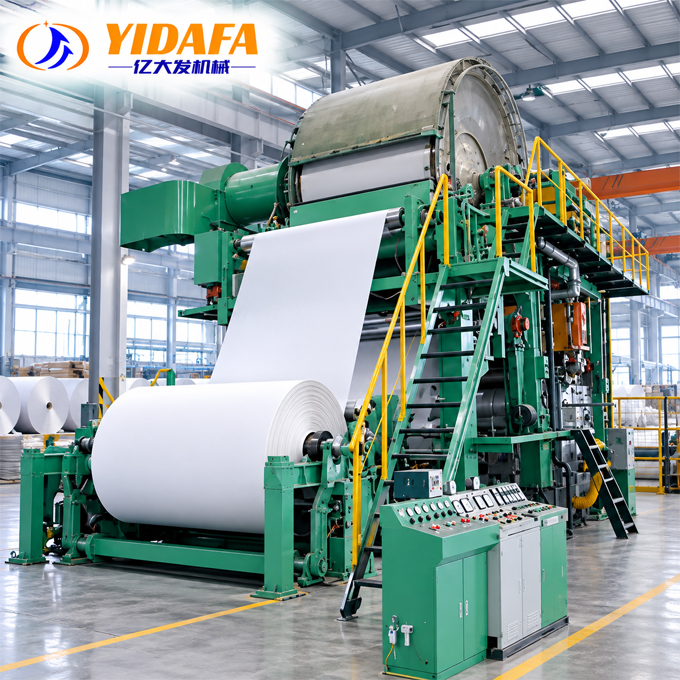
The Bamboo Wood Pulp System Tissue Paper Making Machine is an industrial tissue production solution developed for manufacturers seeking stable output, flexible fiber selection, and consistent finished-paper quality. By integrating advanced pulp handling with continuous tissue papermaking technology, the production line can process bamboo pulp, wood pulp, or blended virgin pulp to produce high-quality tissue jumbo rolls.
Unlike a single-purpose tissue machine, the system can be configured around the manufacturer's raw materials, target paper grades, production capacity, and downstream converting requirements. This makes it suitable for both new tissue paper projects and capacity expansion.
Fiber preparation has a direct influence on tissue paper characteristics. The bamboo wood pulp system provides controlled preparation of the pulp before it reaches the paper-forming section.
The system can include:
Pulp bale or raw-material handling
Hydrapulper and pulp disintegration
Refining equipment
Pulp screening
Centrifugal cleaning
Mixing and dilution
White-water circulation
Approach-flow equipment
Through controlled fiber treatment, manufacturers can adjust the pulp properties according to the requirements of different tissue grades.
The production line is designed as a coordinated process rather than a collection of independent machines.
Virgin Pulp → Disintegration → Refining → Screening & Cleaning → Pulp Mixing → Approach Flow → Headbox → Forming → Dewatering → Drying → Creping → Reeling → Jumbo Tissue Roll
Each section performs a specific function while working together to maintain stable production.
Bamboo and wood pulp are converted into a suitable fiber suspension before refining. Refining conditions can be adjusted according to the desired balance between fiber bonding, strength, softness, and absorbency.
The stock preparation section manages pulp concentration and fiber distribution before the suspension reaches the headbox. Stable flow and consistency are important for uniform sheet formation.
The headbox delivers the fiber suspension evenly across the machine width. Controlled formation helps produce a tissue sheet with consistent basis weight and physical properties.
Water removal takes place progressively through the forming and pressing stages. Effective dewatering reduces the load on the subsequent drying process and contributes to efficient machine operation.
The Yankee dryer is a key component of the tissue machine. After drying, the paper web undergoes controlled creping, which helps develop the characteristic softness, bulk, stretch, and absorbency associated with tissue products.
The finished tissue web is wound into large jumbo rolls. These parent rolls can then be transported to converting equipment for slitting, rewinding, folding, embossing, perforating, and packaging.
A major advantage of the bamboo wood pulp system is its flexibility in producing different grades of tissue paper.
Depending on machine configuration and pulp formulation, the production line can support products such as:
Toilet Tissue
Designed for softness, absorbency, and suitable strength.
Facial Tissue
Suitable for applications requiring a smooth surface and comfortable hand feel.
Kitchen Towel
Can be engineered toward higher absorbency and wet-strength requirements.
Hand Towel
Suitable for commercial, institutional, and public facilities.
Napkin Paper
The jumbo rolls can be supplied to downstream napkin converting lines.
This flexibility enables manufacturers to adjust production according to regional market demand.
The production system can be configured around different virgin-fiber combinations. Bamboo pulp can be incorporated into the furnish where appropriate, while wood pulp provides another established fiber option.
A blended pulp strategy may allow producers to fine-tune:
Paper softness
Fiber strength
Absorbency
Bulk
Formation
Surface characteristics
Overall product positioning
The actual pulp ratio should be determined according to the raw-material properties and final product specifications.
Modern tissue production requires precise control of multiple operating parameters. The electrical control and automation system can integrate monitoring of key production conditions, helping operators manage the production process more efficiently.
Depending on the configuration, automated control can assist with:
Pulp consistency
Flow rate
Machine speed
Dryer operation
Reel parameters
Production monitoring
Alarm management
Equipment coordination
A centralized control approach can simplify daily operation and improve production consistency.
A complete tissue paper project involves much more than the paper machine itself. The production line can be planned according to the available factory space and connected with auxiliary systems and downstream converting equipment.
A typical project may include:
Raw Material Area
↓
Pulp Preparation Section
↓
Stock Preparation
↓
Tissue Paper Machine
↓
Jumbo Roll Storage
↓
Converting Section
↓
Packaging Area
This layout helps manufacturers organize material flow and production logistics more efficiently.
For investors entering the tissue paper industry, selecting an appropriately configured production line is an important step. The machine configuration can be developed according to expected production capacity, finished-product specifications, available raw materials, factory dimensions, utilities, and future expansion plans.
For established paper manufacturers, the equipment can also be used for tissue production expansion, product-line diversification, or production modernization.
The paper machine produces the large parent roll, while converting equipment transforms it into market-ready products.
A typical downstream process can be:
Jumbo Roll → Rewinding → Embossing → Cutting/Folding → Perforation → Packaging → Finished Tissue
This production structure allows manufacturers to separate the papermaking and converting stages and configure each section according to production requirements.
Designed to work with bamboo pulp, wood pulp, or selected virgin-pulp blends.
Suitable for manufacturers requiring continuous tissue paper production rather than small-batch manufacturing.
The forming and stock-preparation sections are designed to support stable sheet quality across the machine width.
The drying and creping system helps develop the softness, bulk, stretch, and absorbency required for tissue applications.
The paper machine can be incorporated into a complete tissue manufacturing project with downstream converting and packaging equipment.
Machine specifications can be selected according to production capacity, paper width, target basis weight, raw material, and factory conditions.
For tissue manufacturers, production efficiency depends on the interaction between pulp preparation, stock approach, paper forming, drying, creping, reeling, and converting.
A complete Bamboo Wood Pulp System Tissue Paper Making Machine brings these stages together into an integrated manufacturing solution. Instead of focusing only on machine speed, the overall system can be engineered around the desired product quality, production capacity, raw-material strategy, and factory workflow.
This approach provides manufacturers with greater flexibility when developing tissue products for household, commercial, hospitality, healthcare, and other consumer markets.
The jumbo tissue rolls produced by the line can serve as the raw material for a wide range of finished products, including:
Toilet paper rolls
Facial tissues
Kitchen paper towels
Hand towels
Dinner napkins
Household cleaning tissue
Commercial tissue products
Hospitality tissue products
The Bamboo Wood Pulp System Tissue Paper Making Machine provides a complete platform for transforming virgin pulp fibers into high-quality tissue jumbo rolls. Its combination of flexible fiber preparation, controlled stock handling, efficient tissue forming, Yankee drying, creping, and automated operation makes it suitable for modern tissue manufacturing projects.
With the right machine configuration and supporting equipment, manufacturers can establish a scalable production system capable of serving multiple tissue-paper applications while adapting to changing market and raw-material requirements.
Looking for a customized bamboo wood pulp tissue paper production line? Machine width, capacity, pulp configuration, automation level, and auxiliary equipment can be selected according to your project requirements.
If you have any needs , please fill out the form below and we will contact you as soon as possible.


