
Traditional wood-pulp tissue production relies on hardwood trees that take 20–50 years to mature. Bamboo, by contrast, reaches harvest-ready maturity in just 3–5 years, regenerates without replanting, and sequesters carbon at rates significantly higher than comparable forest acreage.
For tissue manufacturers, this translates into three operational advantages:
Supply chain resilience: Bamboo plantations can be sourced regionally in Asia, reducing exposure to global wood pulp price volatility.
Regulatory compliance readiness: As the European Union enforces traceability requirements for pulp sourcing — adding audit costs of 5–8% per imported tissue shipment — bamboo grown under certified sustainable practices offers a cleaner compliance pathway.
Premium product positioning: The bamboo toilet paper segment already accounts for approximately 25% of the eco-friendly hygiene segment in 2024, and premium bamboo tissue commands meaningfully higher retail margins.
Not all tissue machinery handles bamboo fiber equally. Bamboo pulp has distinct fiber characteristics — shorter staple length and higher silica content compared to wood pulp — that demand specific engineering adaptations throughout the bamboo paper production line:
A dedicated bamboo pulp processing machine incorporates high-shear refiners calibrated for shorter bamboo fibers, ensuring optimal freeness levels before the headbox. This step is critical: under-refined bamboo slurry produces weak, rough tissue; over-refined slurry collapses fiber structure and reduces absorbency.
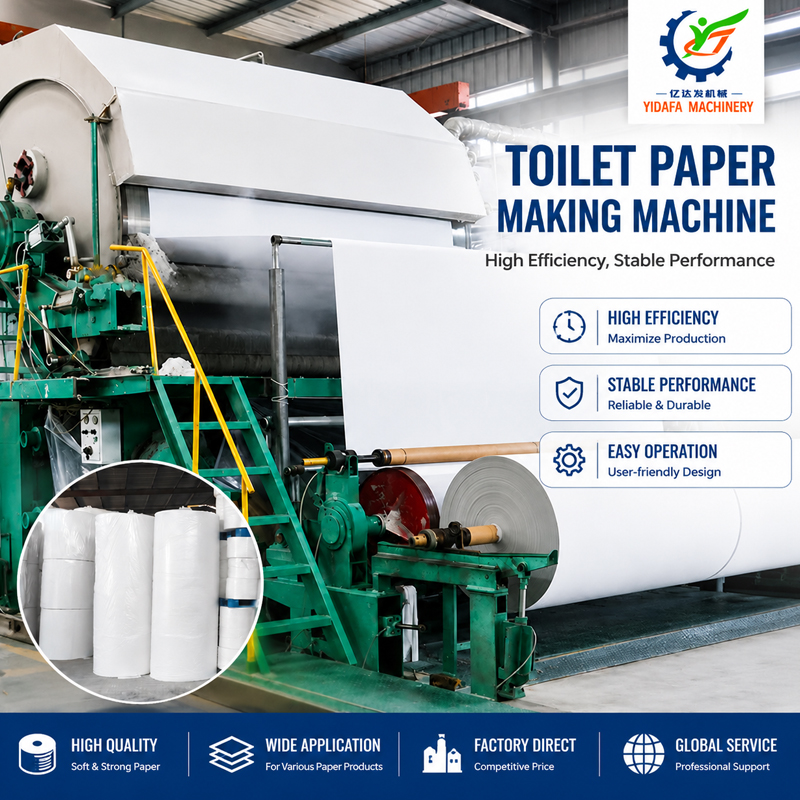
Modern bamboo tissue paper making machines run at forming speeds of 100–200 meters per minute, with twin-wire or crescent former configurations optimized for the lower-freeness bamboo stock. Precise dewatering control at this stage determines final sheet uniformity and basis weight consistency.
The Yankee cylinder — operating at surface temperatures exceeding 90°C — dries the bamboo web to final moisture content before the creping blade imparts the characteristic softness. Machines engineered for bamboo pulp feature adaptive creping doctor systems that accommodate the subtly different fiber bonding properties of bamboo-based sheets.
From the parent reel, the toilet paper production line converts parent rolls into finished consumer or commercial-grade rolls: log saw cutting, embossing (optional), core winding, and automatic packaging. High-throughput configurations process multiple roll formats (standard 2-ply household, jumbo commercial rolls, mini-jumbo away-from-home) on the same line with fast changeover.
The buyer profile for bamboo tissue paper machines has diversified significantly since 2022:
Tissue mills in India, Bangladesh, and Southeast Asia seeking to replace imported wood-pulp lines with locally sourced bamboo alternatives, reducing raw material import costs by 20–35%.
African markets (Ghana, Nigeria, Kenya) where bamboo availability, growing middle-class hygiene demand, and import substitution policy create strong greenfield investment rationale.
OEM tissue brands in Europe and North America establishing production capacity in Asia to serve the surging demand for FSC- or sustainably-certified bamboo tissue under private-label programs.
Existing paper mills diversifying their product mix to capture premium-priced bamboo tissue segments alongside conventional pulp grades.
In B2B procurement, sustainability is no longer a soft preference — it is a contract qualification criterion for major retail buyers, hotel chains, and institutional purchasers. A bamboo pulp toilet paper making machine enables manufacturers to credibly pursue:
FSC Certification for bamboo fiber sourcing
ISO 14001 environmental management system alignment
Carbon footprint documentation (bamboo sequesters ~35% more carbon per acre than equivalent tree crops)
EU Deforestation Regulation (EUDR) compliance — critical for export to the European market from 2025 onward
Manufacturers operating bamboo tissue production lines are better positioned to win tenders from buyers mandating sustainability documentation — a competitive moat that wood-pulp lines cannot replicate.

